

Wine Isn't Suffering from Elitism
It is suffering from people trying to sell us on Egalitarianism

OMG, are we still doing this?
For decades, the prevailing wisdom amongst the wine industry’s thought leaders was that success depended on creating accessibility. We worked tirelessly to “demystify” wine—simpler labels, softer language, fruit-forward blends, mass retail placement (aided very well by the consolidation in retail and in distribution). We thought that by making wine approachable, we would secure its place in everyday life (and grow it). Almost everything I’m reading today STILL talks about the great dumbing-down of wine, wine tasting, wine geography (who cares, am I right?), the non-existence of minerality, and of terroir itself. “Young people crave authenticity!" they say, not realizing the irony of that…
But egalitarian accessibility has a paradox: what is made ordinary is rarely treasured.
Wine once, and still does, occupy a unique cultural role. To know it was to enter a world of history, geography, art, geology, botany, chemistry, and craftsmanship. The language of appellations, terroir, and vintage did not exclude—it inspired, especially those who chose to embrace it. Wine was (is) a code, and those who learned it joined a centuries-old conversation spanning the entire world. Like music, the language of wine is unifying.
By abandoning that language and its mystique, the industry forfeited its sense of aspiration. In positioning wine as a friendly, accessible beverage for everyone, it unwittingly invited comparison with cheaper, simpler alternatives: beer, hard seltzers, canned cocktails. Unsurprisingly, younger consumers, now trained to treat wine casually, gravitated to drinks that out-casual wine itself.
The irony is that wine’s supposed “barriers” were in fact its deepest strengths. Complexity creates meaning. Mystery creates value. Other categories—bourbon, tequila, craft beer—flourished precisely because they leaned into their insider culture and heritage, not because they simplified themselves into banality.
Thus, the uncomfortable truth: wine is not dying because it is too elitist. It’s dying because it made itself ordinary.
Do you want a great read on the business of wine? Take a look at my book when you get the chance.
A couple of reviews here of beautiful wines from small wineries you might enjoy:
2022 Wallis Family Estate Cabernet Sauvignon Napa Valley - A broad-shouldered, brawny wine with full-bodied blackberry, black plums, coffee, and dark chocolate notes, with a little mineral and elegantly medium intensity oak notes. A great value, and a winery worth exploring further.
2022 Patland Malbec “Select Barrel Reserve” Napa Valley - A blueberry and blackberry compote, black cherry reduction with baking spices in a massively extracted, full-bodied, ultra-rich profile - this Malbec is a stunning bottle of wine, both for this winery and this vintage. Seriously impressive work on the balance for a wine with such presence. Go get this.
2022 Vineyard 7 & 8 Estate Cabernet Sauvignon Napa Valley - From the Spring Mountain District, here is a beautifully fruit-forward, but extracted, concentrated Cab with tons of black fruit, classical Cab notes like creme de cassis, espresso, pencil shavings, and some floral notes. I’ve always loved these wines, and the ‘22 is very impressive.
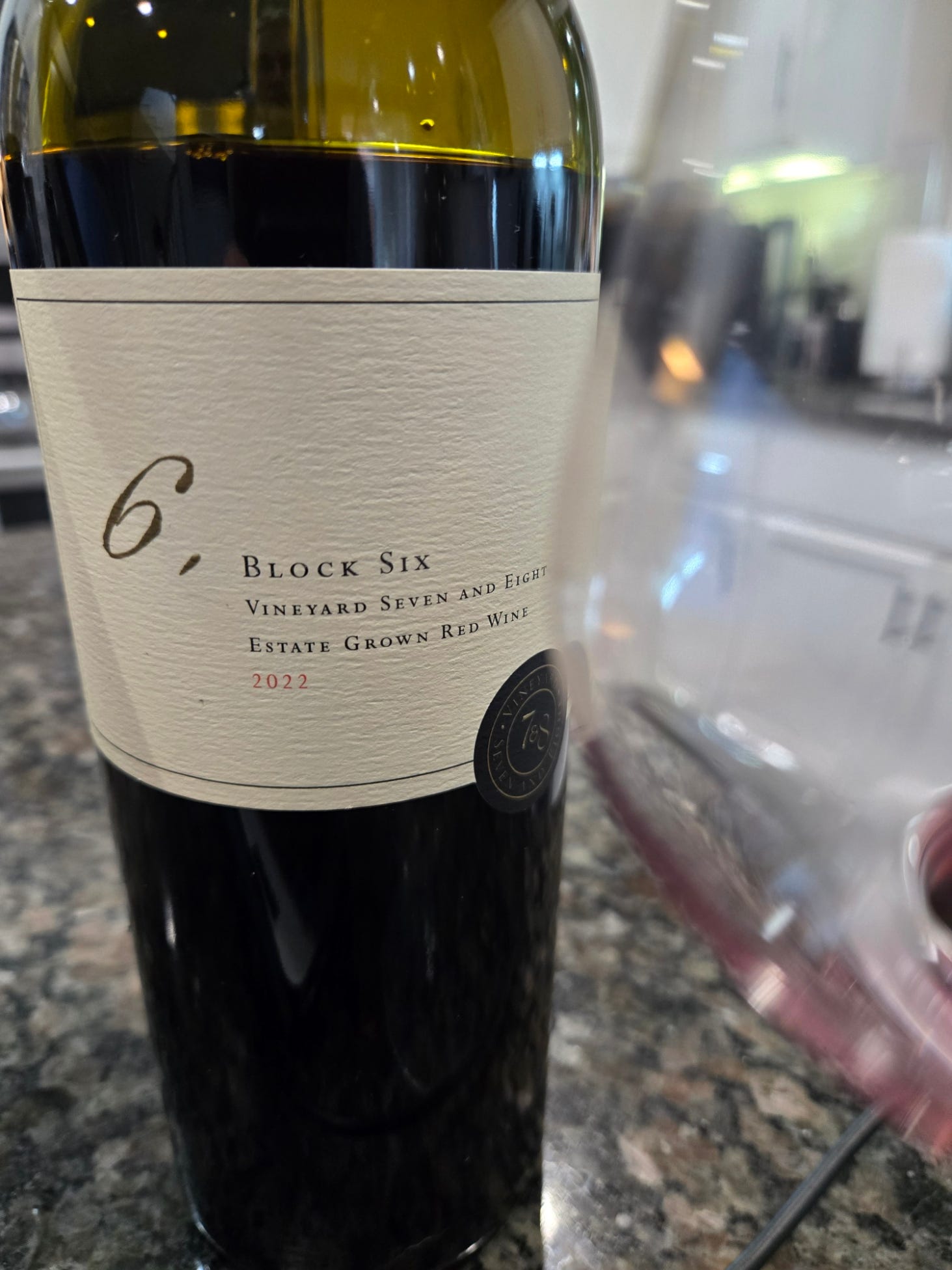
2022 Vineyard 7 & 8 “Block Six” Estate Red Wine Napa Valley - A blended Cabernet with Cabernet Franc and Petit Verdot (presumably), this is a stunning bottle, showing the winemaker’s extraordinary talents, not to mention the beauty of this vineyard. Lots of black fruit, blue fruits, vanilla toasted oak notes, and some dark chocolate, as well some subtle herbs, and baking spices. This is everything you were hoping for, and far more than I expected. This winery is hitting on all cylinders in 2022.
I found this fascinating and it resonated. Among wine’s great democratisers there’s an irony though. Demystification for thee, but not for me. The people who tell us loudest that wine must be made simple and “accessible” are also the keenest to tell us they have the “prestigious WSET diploma”. In truth, it’s Redemptive Elitism – “we will rescue you from the exclusivity of the old order by insisting you follow us instead.” These people claim to dismantle hierarchy. But they’re just re-inscribing it with themselves at the top.
Anti-elitism has kind of become its own form of pretensiousness