


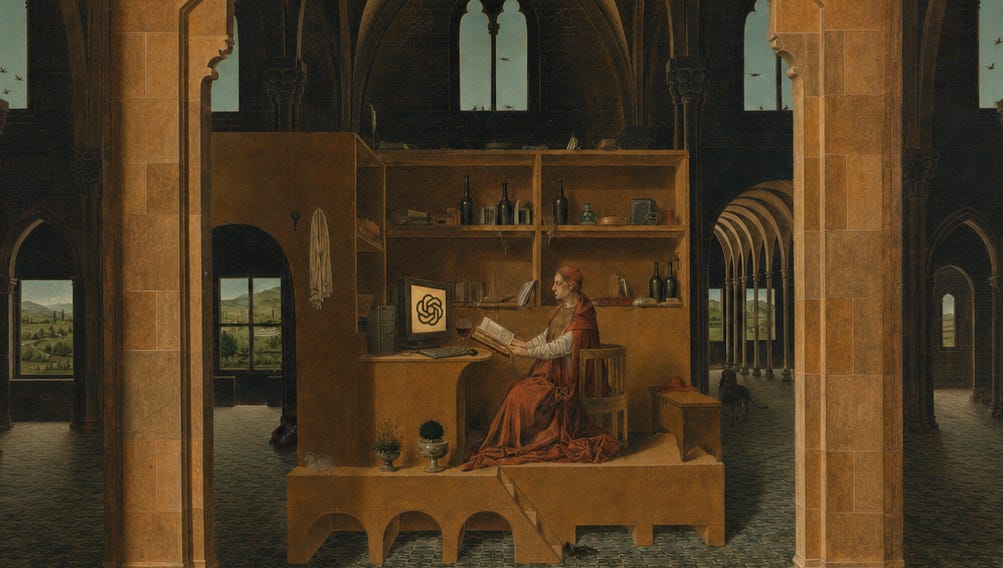
For a long time, years now, our wine business has talked about this disruption as though it were the weather: a low-pressure system moving through, bringing clouds, rain, and a little thunder from wholesale. We’ll grab an umbrella and wait it out until better, more familiar conditions return.
What if the weather is now the climate? Well, it is.
That is the premise of my new book, The Reset Is Over. The pandemic-era distortions are behind us, but they did not return the market to its old shape. Like a crumpled-up piece of tin foil that you can’t quite make flat again, demand for our wines has fragmented. Beyond that, you already know, distribution has consolidated, DTC sales have matured, and the essential middle of the market has lost much of its implied meaning. Capital is far less patient, or enthused; attention is much harder to earn, and the language we’ve built around recovery has become a way to delay decisions that should already have been made.
This is not a book about the death of wine or wineries. It does not pick winners and losers, nor does it count how many wineries and vineyards must be sacrificed to restore balance for the benefit of the incumbents. It is a book about the end of expansion thinking and about the more durable businesses that can emerge once we stop negotiating with our collective reality.
What follows is a brief tour through my arguments: selected passages and excerpts from the Foreword and across the chapters of the book. Each extract stands on its own while pointing toward the larger premise.
Excerpts have been lightly edited for length, punctuation, and continuity.

From the Foreword, by Paul Gregutt
Picking up where his first book left off, Jim insists that for all intents and purposes the dramatic changes that have upended every single aspect of making and selling wine are now baked in. The reset is over. And it’s time to accept that reality, and begin to strategize for conditions that may not be favorable, but are more or less permanent. The wine business is not going back to whatever halcyon time you may fondly recall, he says, so let’s move on.
Waiting, Jim goes on to insist, is not a successful tactic. And he carefully and clearly presents actionable moves to keep your wine business balanced, healthy, and sustainable. “Wine is no longer assumed to belong in every moment,” he writes. “It has to fit.”
How and where and when it can fit is one of the most important themes of this book. At times, these ideas read like koans—challenging and disrupting presumed logic and provoking “Aha” moments. To me, this is the magic of this work. It can feel as though you’re hacking your way through a thicket of concepts, unsure of where they are taking you. But when you come out of that confusion and into a moment of clarity, the payoff is that it may ignite your own thinking in unanticipated and even revolutionary ways.
Thank you for the Foreword, Paul. I appreciate it enormously, and the Zen reference too.
From Chapter 1: The Market Did Not Snap Back
The book begins with an argument about acceptance. Before a business can change its strategy, it has to change the language it uses to describe the world.
The market did not snap back. It did not correct upward. It did not return to a familiar trend. It settled where it was, into a low ground, like fog finding the swale. And once a market settles, the language matters. When leadership teams continue to speak in the grammar of interruption—pause, headwinds, hangover, recovery—they are no longer describing reality, but negotiating with it. And now, the negotiations are over.
One of the more misleading features of the last five years is that the reset did not arrive with ceremony. There was no industry-wide reckoning, no collective admission that the ground had shifted, no moment when everyone agreed to rewrite their assumptions at once.
Instead, the reset occurred quietly, concurrently, and unevenly. Distributors reduced SKUs without announcing a strategy change. Banks tightened lending standards without publishing new rules. Retailers shortened buying horizons without changing shelf language. Consumers drank less wine per capita without declaring their intentions publicly—until they did. Nothing happened. Everything happened.
The danger is not volatility. It is stability at a lower level, especially for businesses still designed around expansion.
From Chapter 2: Stop Marketing to Birth Years
If demand has fragmented, the useful question is no longer simply Who is the customer? It is What is the moment?
One of the most persistent errors in modern wine marketing is our industry’s fixation on demographics and generations. Millennials. Gen Z. Boomers. These categories are endlessly debated, subdivided, and blamed. They make tidy panels, good talking points, and clean slides, but they rarely lead to better decisions.
Psychographics—values, motivations, anxieties, and aspirations—are far more predictive of wine behavior than age or income alone. Two consumers of the same age may drink wine for entirely different reasons, or not at all. One drinks for craftsmanship and story. Another for relaxation. Another for food pairing. Another for status. Another avoids wine because it feels heavy, formal, or exclusionary.
People do not drink wine because of their age. They drink wine because of context: where they are, who they are with, what kind of day they have had, and what the moment requires. Those forces cut across generations far more cleanly than birth years ever will. The relevant unit of analysis is not the consumer, but the occasion.
A Tuesday night at home is not a Friday dinner out. A wedding is not like a business trip. A summer afternoon asks different things from wine than a winter holiday. Those differences shape price, attention, frequency, and repeat purchase. Wine is no longer assumed to belong in every moment. It must fit.
From Chapter 3: Price Is a Form of Self-Knowledge
Pricing is often treated as a calculation performed after the important decisions have been made. In a durable business, price is part of the architecture.
Price conveys far more than quality. It signals confidence, restraint, self-knowledge, and seriousness of intent. Consumers are often willing to pay more when the price feels considered, even if they cannot fully explain why. They resist prices that feel accidental or defensive, even when the wine itself is sound.
The most dangerous price point in today’s market is the middle one created by indecision. Not expensive enough to be intentional, not affordable enough to be easy, but suspended somewhere in between, carrying the residue of compromise. Durable wineries ask different questions. Does this price make sense for how often this wine should be purchased? Does it fit the occasion for which it is intended? Does it align with the alternatives competing for that moment? When the answer is yes, resistance diminishes. When it is no, there is no explanation that will repair it.
There is also a meaningful difference between discounting and resetting a price. Discounting responds to pressure. It trains customers to wait, channels to ask, and retailers to expect concessions. A price reset, by contrast, acknowledges misalignment. It happens once, is applied consistently, and is paired with clarity. A reset should feel like the wine finding its proper place, not like the winery asking for relief.
The point is not to price without humility. It is to price without apology—or delusion.
From Chapter 4: Your Email List Is Not Your Audience
Direct-to-consumer sales remain essential. But the miracle years are over, and the meaning of the channel has changed.
One of the enduring myths of modern wine marketing is that an email list represents latent demand. It does not, precisely. It represents past permission.
An email address is a record of a moment when someone cared enough about you to say, “I’m interested.” That moment may have occurred in a tasting room, at a pickup party, after a particularly good review, during a pandemic-fueled buying spree, or after a single holiday purchase. What matters now is not the size of that list, but the quality of the relationships that followed. Do they buy again? Do they consolidate purchases over time? Do they disengage quietly? Do they respond only when incentives are present?
Email remains one of the few channels you truly own. No algorithm can de-platform you. No retailer can delist you. No distributor can throttle your access. That alone makes it strategically valuable. But ownership is not the same as effectiveness. An unengaged or neglected list is not an asset. It is a liability that consumes attention, creates false confidence, and distorts decision-making.
DTC is no longer a miracle, and that may be good news. It is something more useful: infrastructure. It works when it is treated as a relationship system rather than as a pressure valve for excess inventory.
From Chapter 7: The Comfortable Middle Is Gone
For decades, the middle of the wine market was where seriousness lived. It did not need much explanation. That assumption no longer holds.
The $20–$40 tier was where quality could be assumed without apology, where price implied intent, and where brands could grow steadily without needing either mass-market volume or luxury signaling. It did not require deep thought or explanation. It simply worked. But that era is essentially over.
The collapse of the middle did not arrive as a single event. It arrived as a slow unmaking: costs rose, distributor portfolios tightened, value wines improved below, and luxury narratives sharpened above. Consumers stopped defaulting to wine the way they once did. Each pressure on its own felt manageable, but taken together, they drained the middle of its only true advantage: implied meaning.
Wines below the middle became cleaner, better packaged, and easier to understand. Wines above it learned how to speak more clearly about scarcity, place, and status. The middle, by contrast, often continued speaking in an older language—appellation, score, vintage, seriousness—as if those things still explained value on their own. In many cases, they no longer did. What had once been the most comfortable place in the market slowly became the least understandable.
The middle is not necessarily disappearing as a price band. It is disappearing as a place where a winery can stand without making a clear choice.
From Chapter 8: Correction Has an Emotional Cost
The numbers may tell you what to do. They do not make doing it emotionally easy.
Corrections are exhausting in a way distinct from other kinds of business difficulties. Growth problems are exhausting because of the pace—too much happening, too fast, with not enough infrastructure to support it. Correction problems are exhausting because of the restraint. You know what the right move is. You can see it clearly. And you sit with it, sometimes for months, because making it feels like giving something up that you worked very hard to build.
The owner cannot bring themselves to cut the SKU they are most proud of, even when it has not found its market in three vintages. The general manager keeps an underperforming market on life support because walking away feels like admitting they were wrong to enter it. The winemaker makes the wine they want to make rather than the wine the current economics support, because the alternative feels like a compromise of everything they came here to do.
These are not irrational responses. They are human ones. Wine is not a category that attracts people who are indifferent to what they are producing. The emotional investment is real, and it makes the work of correction genuinely hard.
The grief is appropriate. But businesses that correct honestly and early often describe what follows as clearer than what came before: fewer things to defend, fewer stories to tell, fewer channels to manage, and more alignment between what the business says it is and what it actually does.
From Chapter 10: The Doom Cycle Is Not a Strategy
Wine is under pressure; however, that does not mean every pressure point is evidence of collapse.
In recent years, a familiar cycle has become visible. A data point emerges showing declining shipments, shifting demographics, or rising inventory. Commentary follows quickly. The narrative expands from observation to diagnosis. Soon, the language changes. The market is “collapsing.” Wine is “losing relevance.” Consumers are “abandoning the category.” None of these statements is entirely accurate, but all of them spread quickly.
Welcome to the doom cycle: repeated framing that emphasizes decline even when the underlying system is merely adjusting.
Narratives of crisis attract attention because calm explanations rarely do. “Wine is maturing into a more competitive category” does not travel as fast as “Wine is dying,” even when the first statement is closer to the truth. The result is a fragmented media ecosystem that can make normal market evolution feel like catastrophe.
The opposite of panic is not denial; rather, it is interpretation: separating the data from the emotional story we tend to build all around it, then deciding what the evidence actually requires us to do.
From Chapter 11: Brand Is What You Do Under Pressure
Branding is visible when things are easy. Brand becomes visible when they are not.
When inventory rises, does pricing remain disciplined or collapse into promotion? When shipments slow down, does the winery panic or stay consistent? When a vintage—or smoke and fire—challenges quality expectations, does the winery protect standards or rationalize compromises? When a distributor reshuffles priorities and your brand is no longer on the tip of anyone’s tongue, do you respond by redesigning the label or by showing up more consistently?
Moments like these reveal the difference between branding and brand, because branding is presentation, but the real brand is in the behavior.
Behavior under pressure is rarely subtle. It shows up in emails that suddenly contain more urgency. It shows up in discounts that were once “special” becoming monthly promotions. It shows up in the new internal permission structure created to break rules that were once sacred. The winery’s voice becomes less calm and starts to sound needy. The cadence becomes erratic, and decisions become reactive.
Wineries often believe they are making temporary adjustments. The market experiences those adjustments as identity. I know this very well. I’ve been there.
From Chapter 12: AI May Make Wine More Human
Artificial intelligence will make competence cheaper. Doesn’t that sound good? That changes where value lives.
The irony at the center of the AI disruption in wine is worth sitting with for a moment. The machine may ultimately make wine more human, not less.
Once AI begins handling reporting, forecasting, compliance processing, inventory reconciliation, customer-service triage, and basic marketing production, what remains is the part wine should always have been emphasizing: hospitality, ritual, conviviality, belonging, storytelling, the taste of a place, and the memory of the person who opened the bottle. These are the things the industry buried beneath dashboards, software integrations, and committee-built marketing plans. We became obsessed with optimization because optimization was measurable. But the things consumers actually love about wine are not measured in these ways.
AI does not eliminate those things. It amplifies their importance. Once marketing, logistics, administration, and content become effectively infinite, competence alone stops differentiating anyone. Efficiency becomes abundant. Generic communication becomes abundant. What becomes scarce is genuine human connection, authentic perspective, and emotional resonance.
Scarcity, as the wine business understands better than almost any other industry, is where value begins.
From Chapter 13: Contraction Can Be Clarifying
The book ends where a book about the present wine market should end: not with optimism as mood, but with clarity as advantage.
Periods of contraction often clarify what expansion had obscured. Inefficient distribution becomes visible. Overextended portfolios reveal their fragility. Wines that once moved easily begin to stall, and the reasons why are suddenly easier to see. Maybe the SKU was never clearly positioned. Maybe the price corridor never truly held. Maybe the distributor relationship was never particularly deep.
This process is uncomfortable because it removes the illusion that effort alone produces success. It forces businesses to confront structural questions that were easy to postpone during better years. But this is also how mature industries refine themselves.
What emerges is a clearer separation between systems that were inherently sound and those that depended on favorable conditions. Sustainable businesses made consistent decisions long before the downturn. They know where they sell, to whom, and why. Their pricing holds because it was built with intention. Their relationships are grounded in repeatability, not opportunism. They did not unravel.
Contraction forces a kind of honesty that growth allows businesses to defer: What are we actually good at? Where do we belong? Which customers return without being asked twice?
Those questions are not signs of retreat. They are the early foundation of durability.
Opus in futurum
The Reset Is Over is not one guy’s argument for making the wine business smaller simply for the sake of making it small. Nor does it predict that only luxury survives, wholesale is finished, DTC has failed, or technology will sweep away the human work. None of those things is true. It is one guy’s argument for coherence.
Produce what the market can absorb without depending on rescue. Price according to role rather than accumulated anxiety. Treat DTC as a genuine relationship system. Enter fewer markets, seriously, and with clearer expectations. Understand what your brand promises before pressure arrives. Let technology remove friction without allowing it to remove humanity. Measure growth less by expansion than by the ability to remain recognizable to customers, employees, partners, and yourself.
The reset is over, but the story isn’t. We can finally stop waiting and begin the more interesting work of building for the market that is actually here. =33=
The Reset Is Over: How to Build a Wine Business for the Market That (Actually) Exists is now available for preorder at a reduced price and will ship September 1. If these excerpts describe the market you are navigating, I hope you’ll read the complete book.
My first book, The Post-Pandemic Wine Market, remains the practical handbook: how to run a winery, how its functions fit together, and what an aspiring general manager or an owner trying to understand the people around them needs to know.
To actually begin reading the book at no charge, first create a free account Imbiblio .
Then read the opening chapters here at this link.
I’ve also switched on paid subscriptions and pledges. Partly because paid support helps this work travel farther on Substack, and partly because independent writing still requires support. If you find these essays useful, becoming a paid subscriber would mean a great deal to me. If not, no worries; a restack is always appreciated. Starving consultants accept both.
Founding Memberships include a copy of my new book, signed by me.
Jim Silver is a sales and operations consultant at Napa Valley Consulting, where he advises wineries on DTC and wholesale strategy, sales and marketing structure, and financial and operational growth. He is the author of The Post-Pandemic Wine Market: A Practical Guide (2025) and The Reset Is Over: How to Build a Wine Business for the Market That (Actually) Exists (2026). His essays draw upon more than three decades of experience in winery sales, operations, and leadership across the wine industry.
If you would like to discuss your winery, business challenges, or growth opportunities, Jim and Napa Valley Consulting founder Chris McDonald, CPA, are always happy to have a conversation. You can reach Jim at jim@napavalleyconsulting.com.
P.S. Jim is also the author of the gothic adventure novel The Harvester of Eyes and a tabletop gaming module of the same name, because apparently the wine business was not dark enough.
Jim - when I use the link provided to preorder the book, I do get the 20% off applied. However, when I take the second step and add the first book, while it discounts the first book appropriately, I apparently lose the 20% off the preorder and the new book goes back to full price. Is this intentional or is this a glitch in the application of the discount process?
Paralysis is the moment, actionable insights to get unstuck out of the middle.