

Noblesse Oblige
And the Cost of Leading by Spreadsheet

The wine business is contracting, as we all pretty well know by now. Not all at once, despite how it may feel, but in the familiar, ritualized way that has come to define downturns in this business. Positions, often senior ones, disappear as teams are reduced in the name of prudence. Departures are explained carefully, sometimes with assurances that they are temporary measures taken in uncertain times. We have seen this before, but what feels different now is how little resistance there seems to be around the decisions themselves. The moment pressure appears, the response becomes robotic. Payroll is trimmed, headcount is broadly reduced, and the explanation arrives wrapped in discipline and focus. The spreadsheets are approved, the models show improvement, and yet the business itself, more often than not, does not.
There is an older idea worth revisiting here precisely because it feels so unfashionable: noblesse oblige. The notion that advantage carries responsibility, and that those with land, capital, brand equity, and optionality have an obligation, not sentimental and not charitable, but structural, to steward the systems and people that make those advantages possible. Wine, of all industries, should understand this instinctively. I believe our industry has always carried some of this in its collective DNA. Still, we speak constantly about history, patience, and legacy, and we sell continuity. We ask customers to believe in time doing its work. And yet when pressure arrives, leadership often behaves as if the business were a short-term arrangement, measured in quarters, rather than a long-held estate.
What we are witnessing across much of the winery landscape is not the much-needed strategic recalibration so much as spreadsheet leadership. Leadership that begins and ends with models, treating labor as a variable to be optimized rather than a capability to be developed. Leadership that mistakes decisiveness for depth, and short-term relief for long-term health. It produces clean slides, defensible talking points, and just enough reassurance to satisfy boards and lenders. What it rarely produces is durability.
Spreadsheet leadership seldom asks whether the business is too diffuse to support the structure around it. Complexity is preserved, and people are removed. SKU counts remain bloated, brand architecture stays unresolved, channel strategies overlap and compete internally, and side projects linger long past their expiration date. I know this not only because I have observed it, but because I have been part of versions of it, and it took time to learn that these choices solve a spreadsheet faster than they solve a business. And yet the first lever pulled is almost always headcount, particularly in sales, hospitality, and brand-facing roles, the very functions responsible for turning wine into demand. Instead of restraint, you get displacement. A spreadsheet offers the market no relevance and creates no trust. You erode the human systems that make a wine business legible to the market.
This is where obligation matters most, especially for wineries operating from positions of real financial strength. Yes, costs must be addressed, and inefficiencies should be removed. Excess should be confronted honestly. But when well-capitalized wineries respond to pressure by preserving portfolio sprawl while dismantling their sales and marketing engines, they are not practicing the right kind of discipline.
To be fair, inertia sets in. Projects started three years ago, before the true deleterious nature of the downturn was understood, can feel too precious to abandon. Contracts are in place. Investments are sunk. It becomes easy to proceed into the business buzzsaw with the bloat intact, because quitting can feel like losing. The sunk cost fallacy is persuasive precisely because it gives emotional cover to avoidance.
These are harder decisions, and we should sympathize with the bind. But sales and marketing are not overhead in this business. They are the means by which clear messaging becomes demand, pricing holds, distributors stay engaged, and restaurants remember why a wine matters. Put bluntly, reducing your sales team before exhausting other inefficiencies is usually the wrong move. If a business is struggling to sell, the answer is rarely fewer people in the market. It is fewer distractions, fewer wines, and better people carrying your bottles.
Durability has never come from being everywhere. SKU proliferation is one of the most corrosive and least acknowledged taxes in the modern wine business. Every additional wine carries not just production costs, but also selling, marketing, and cognitive costs. It fragments attention, weakens conviction, and forces explanation where confidence should suffice. Tighter portfolios create belief. They allow the people representing the wines to speak with authority, and they replace noise with hierarchy.
Cutting sales capacity at the moment when portfolios most need clarity and defense is counterproductive. Spend even a short amount of time on WineJobs.com, and the signal is unmistakable. Experienced, capable sales talent is suddenly abundant, not because these people failed, but because some businesses chose speed over stewardship. For wineries with real product integrity and focused offerings, this is not a moment to retreat from selling. It is an opportunity to strengthen the connective tissue between brand and market.
The industry’s ongoing argument about DTC versus wholesale has also become a distraction, largely because it is framed as ideology rather than governance. DTC and wholesale are tools, governed by different economics and suited to different forms of reach. DTC is where margin lives and intimacy compounds. It is the right place for experimentation, limited releases, and deeper storytelling. It is also operationally heavy and finite. Wholesale is where visibility is earned and sustained, where wines are encountered without ceremony and judged on their own terms. It is lower margin and slower moving, but it is how relevance extends beyond the tasting room and the mailing list. Durable wineries need not debate belief systems. They should govern balance.
I recognize that much of my recent writing urges wineries to lean harder into DTC, and that emphasis is intentional. Direct relationships remain the most controllable and resilient source of margin, insight, and leverage most wineries will ever have. But balance matters once a winery has earned it. For producers that already carry prestige and are already present in functioning wholesale channels, there is value in governing both systems rather than retreating from one entirely. Wholesale, when approached deliberately and kept in proportion, can extend relevance, reinforce stature, and place wines into everyday cultural circulation in ways DTC alone cannot. This is not an argument for seeking distribution prematurely, nor for chasing wholesale as a solution if it has never worked. It is a reminder that, at maturity, leadership is less about choosing sides than about managing each channel with clarity, restraint, and purpose.
Noblesse oblige also asks something practical of winery leadership in moments like this: to look hard at who is available, not just what is cheapest. This is not an argument for charity, nor for employing anyone out of sympathy. It is an argument for discipline that recognizes experience as an asset, especially when it is unusually available. The current labor market is rich with mature, deeply experienced professionals who helped build this industry and now find themselves displaced through no failure of their own. Many would gladly return to work, often in right-sized roles with aligned expectations, sometimes for less than they once earned, not out of desperation but out of realism and commitment. Fair pay still matters, and dignity matters more. For wineries, this represents a rare convergence of responsibility and self-interest. Hiring seasoned people brings judgment, command, and institutional memory at a time when those qualities are most needed, while often reducing the costly mistakes that inexperience invites. Even considering the value of those who helped build this industry is not charity. It signals a leadership instinct grounded in continuity rather than convenience.
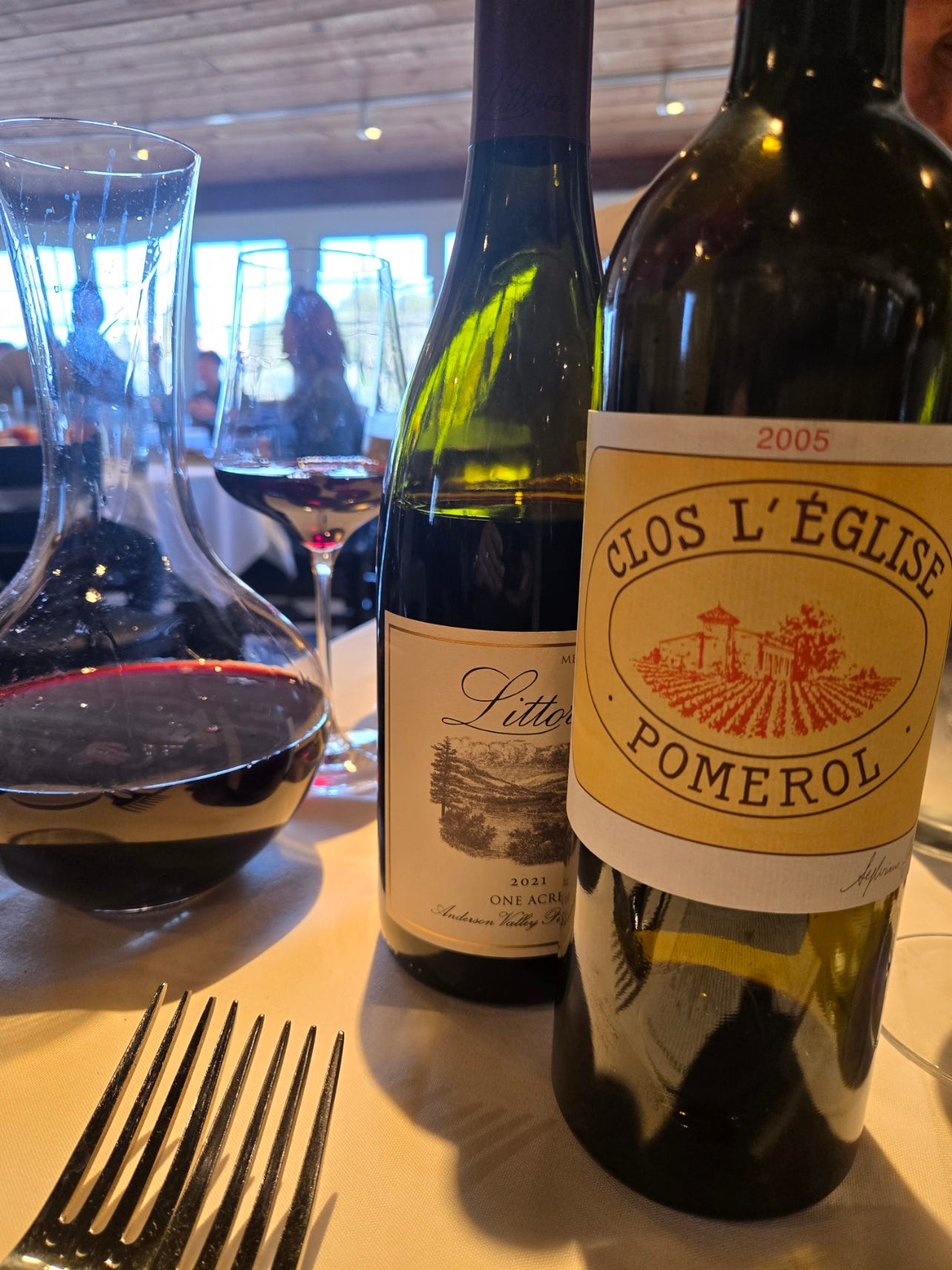
Just one review this time, of the 2005 Clos L’Eglise Pomerol, drunk at Mustard’s Grill with my friend Ellis. It’s safe to say that I am enamored of Pomerol lately, and why not? This is the kind of wine you put next to Petrus, and it hangs alongside it easily. Without flashiness, it is purely, warmly, intensely rich, earthy, mineral, with black fruits, tobacco, and shaved pencils. Perfect balance and poise, and unbelievable complexity. And I had it with the wings. Easily the best chicken wings in California.
Next to it, the unfortunate 2021 Littorai “One Acre” Anderson Valley Pinot Noir showed amazing presence and depth, but was corked nonetheless. The kind that gets worse the more air you introduce to it, not the opposite… too bad for us, but I’ll bet it would have been very good indeed.
A great article and well timed. A friend was let go after 18 years from a wine & spirits company and I know their work ethic and relationships are irreplaceable. It’s a shame. I found myself back in the restaurant business out of necessity, as I grew tired of losing out in the final rounds to those with almost zero experience and less provable hustle. (Sigh). Keep the articles coming! Cheers.
Terrific article. Thank you.