


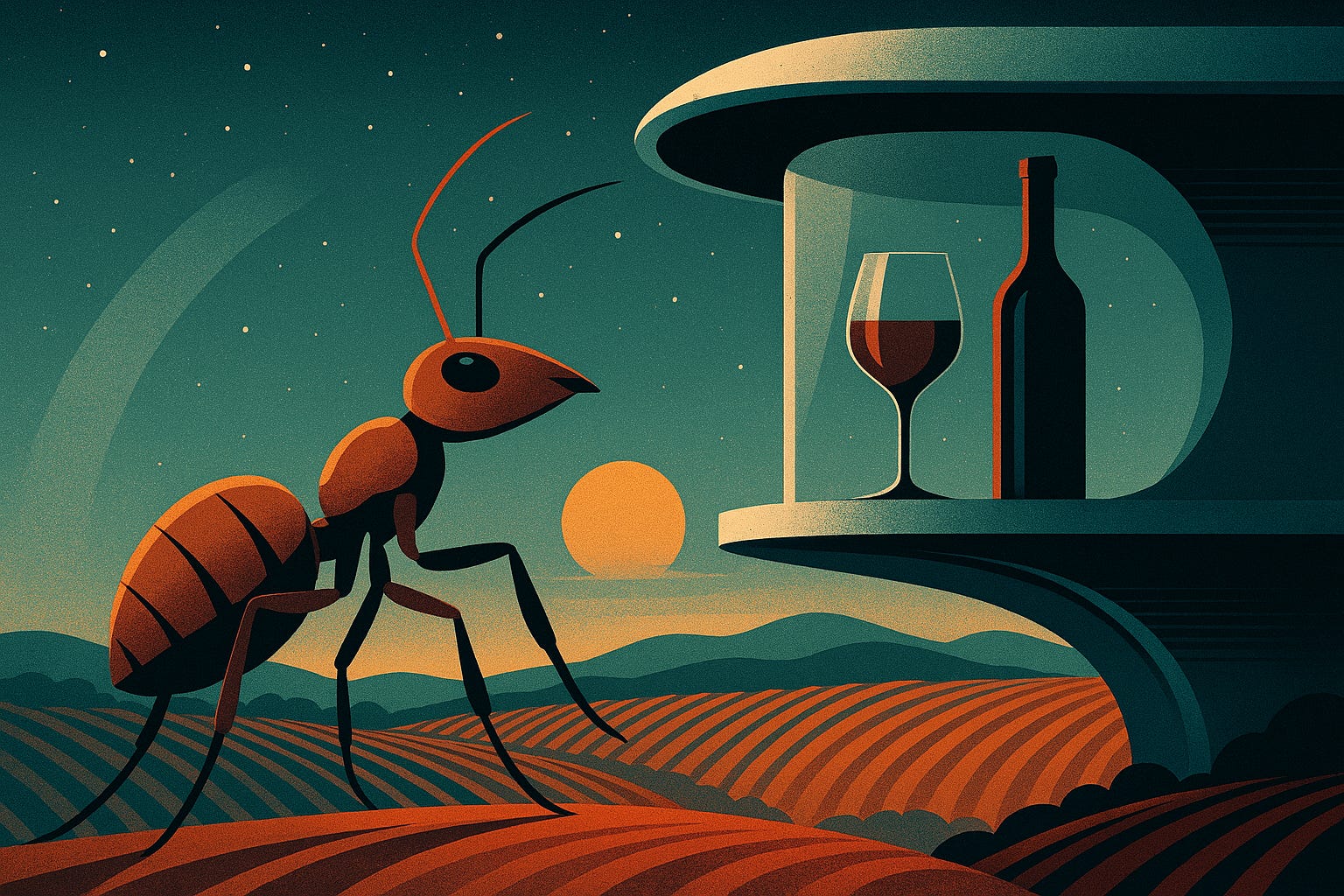
I don’t think I am especially well-read, but one book, published in the 50s, that I read in the 80s has always stuck with me, and one part in particular. In Book I, Chapter 13 of The Once and Future King, T.H. White turns the future king, young Arthur (the Wart as he is known), into an ant. Inside the ant colony, he discovers a world stripped of nuance. The ants’ language recognizes only two utterances, “done” and “not done.” There are no words for happiness or freedom, no vocabulary for taste, preference, or dissent. As the narrator explains, if a word does not exist for a thing, that thing cannot be pondered; and if it cannot be pondered, it will never become a consideration in anyone’s life. The result is obedience to a system that leaves no room for choice.
The author uses this binary vocabulary as a parable, a bit like Orwell’s “newspeak” – to show how language can constrain imagination and, by extension, behavior. When experience is limited to “done/not done,” judgment becomes procedural rather than thoughtful. Desire is muted, discovery accidental.
Now consider the modern U.S. wine market. For a significant portion of alcoholic beverage drinkers, our wine category is communicated through a similarly dualistic filter, though not by someone’s decree, but by habit. Wine is open/closed, red/white, sweet/dry, and priced high/low. Much of the market operates within a linguistic or a conceptual palette that reduces wine from a world to be discovered into a consumer packaged good. If White’s ants live by “done/not done,” modern wine consumers often live by “buy/not buy.”
This is not a moral failing, is it? It is a structural outcome shaped by how we, the producers, retailers, critics, and platform architects, construct the journey of discovery.
On the one hand, we see a cohort that drinks less frequently, spends cautiously, and gravitates toward simpler decision sets. On the other hand, a cohort that is highly engaged, willing to pay for scarcity and story, and responsive to well-executed direct-to-consumer hospitality, although smaller than it once was. The well-regarded Silicon Valley Bank’s (et al) diagnoses of the demographic rotation away from older, wine-centric Boomers and toward younger folks with lower category engagement are well known to anyone reading this. It is an evolution that compresses demand, upends long-held playbooks, and has us basically running in circles.
Simultaneously, direct-to-consumer channels, as I have long called a refuge for “soulful, complex, and limited wines of dignity and artistry,” have felt the gravity of reality. The latest data show 2024 DTC shipments declining 10% in volume and 5% in value, with lower-priced segments ($40 and under) falling fastest and the ultra-premium tier slowing to low-single-digit growth. And that’s just the good news.
The marketing mind’s binary emerges here. One segment orbits convenience, routine, and availability, the “open a bottle tonight” or by extension the relearning of event-based, celebratory consumption like “come over October”. The other mindset circuits meaning, embodied by scarcity, terroir, narrative, craftsmanship, and the intimacy of hospitality. The US may be the largest wine market by far, with California dominating production, but volume growth has flattened. While the number of wineries proliferates, and the route to market narrows to a trickle, we find an ecosystem where discovery competes against noise.
If some drinkers feel they cannot express what they truly want, it may be because our category often speaks to them in an ant-language of features (ABV, varietal, residual sugar) and more binary cues (oak/no oak, red/white), rather than a human language of experience (place, texture, mood, memory, socialization).
The ant colony illustrates a deeper principle, that vocabulary precedes vision. Remove words like joy, choice, and liking, and you remove paths to them. In wine, when discovery is framed primarily by grape and score and price, many consumers never hear the words that would open doors: texture, lift, line, minerality, umami, crunchy fruit, tannic grip, refreshing, velvety, and surely there’s more.
A consumer without those words cannot easily ask for them. And without asking, they cannot discover. And if we can find a way to give them the words, where will they take them?
We already know that younger consumers engage more when a product aligns with values they aspire to, like authenticity, sustainability, and story, as well as sincere environmental practices and transparent narratives, while showing moderation and category fluidity when compared to older drinkers. There is a structural decline in regular wine consumption post-pandemic, coupled with a premiumization that favors quality on fewer occasions. This requires us to lean into DTC, its vocabulary, and its aesthetic even more, as the done/not-done chain stores and grocery stores will further deplete choice and distill selection down to velocity-driven wines that are anything but discoveries. It is inevitable, to me, that wine-centric people, new or experienced, will rely even more on subscriptions and allocations, not just of domestic favorites, but imported ones, too.
All of this suggests that the path beyond “done/not done” is experiential. Give people the words they need, and they will find their way in our world.
Sure. But how?
If the problem is language, the work is translation. Let’s try some interventions that move the conversation from ant-colony minimalism to human-scale meaning.
Replace “oak-aged Chardonnay” with “sun-warmed stone fruit and roasted hazelnut; supple texture that widens at mid‑palate; calm finish.” I think sensory metaphors are fun – but then again, I love wine, don’t I? The more precise the descriptor, the more requestable and memorable the experience becomes. Their own research proves the search for authenticity exists. So, we name the feeling, not just the feature.
“Whole‑cluster ferment for lifted aromatics; gentle cap management for silkier tannin.” Tell how these wine-making decisions shape the feel. Wine enthusiasts already listen; casual drinkers will if the language is warm and somewhat non-technical. We know that premiumization trends hinge on perceived quality and authenticity, not just scarcity.
Teach them the useful micro-words with one-minute reels or tasting-room cards featuring a small but potent, understandable lexicon: tension, line, nerve, fruit-sweet, lift. This isn’t all jargon, but it can be difficult to understand. It’s a bridge to this world. Is it possible for vocabulary lessons to be community-building? DTC is still the anchor to this sort of engagement.
As I alluded to before, and in a similar vein to Come Over October, we can sell occasions rather than just deals. Framing club and new vintage releases as occasions with mood boards, menus, ideas for socialization, and playlists. Can you believe I had to say, “ideas for socialization”? We’ve fallen so far into our phones, I’m afraid. The future should be defined by occasion-based campaigns for younger consumers. Let’s lean into it.
If you read my book, you know I talk a lot about psychographics over demographics. Younger drinkers tolerate neither greenwashing nor platitudes. Demonstrate, and tell the farming in exact terms, because they can take it. What are the cover‑crop species, irrigation thresholds, biodiversity indications, and glass weight decisions? Still, we know that Gen Z values sustainability but demands substance.
You and I both should avoid labeling the other tribe’s wines as “boring.” The Everyday Cohort seeks reliability, clarity, and low cognitive load. Their ant language is safety: Is it good for dinner tonight? Will guests like it? They respond to straightforward narratives, crisp signposting, and trusted recommendation architecture (e.g., chef pairings, occasion tags). And yet, they are feeling the effects of inflation too.
The Engaged Cohort, that’s you, me, our friends – we seek beauty, difficulty, and surprise. Our language is exploration: What’s new? What’s scarce? What’s the winemaker wrestling with? We respond to precision vocabulary, deep hospitality, scarcity to a point, and the intimacy of a club. We carry on, but the way is getting rougher by the minute.
We should not force one cohort into the other. We’re here to expand the everyday lexicon so some portions of the first group can hear themselves wanting more. We’ll have to stabilize the ‘engaged’ vocabulary so the second group remains delighted, without feeling extracted. (Ooh, extracted… Good word.)
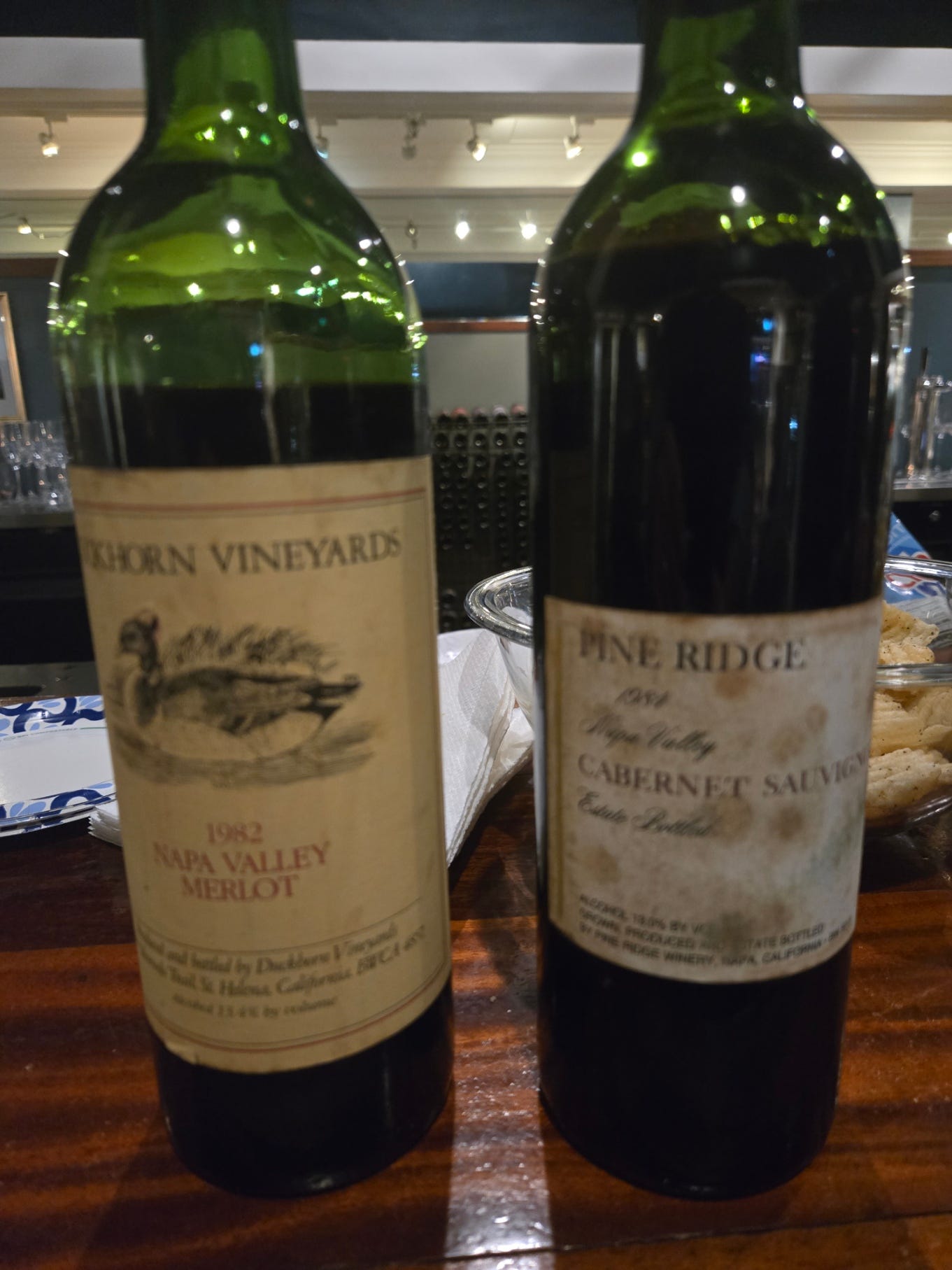
Here are a couple of Napa wines I didn’t expect this week, and sorry for the blurry picture. The 1982 Duckhorn Merlot was an extremely good example of this bottling and must have been stored under impeccable conditions. It was alive, breathing, dazzling really, and still had enough true complexity to make you forget Cabernet completely. It remained fit and well for hours! But speaking of Cabernet, the 1984 (singularly my favorite Napa vintage ever) Pine Ridge Estate Bottled Cabernet Sauvignon was utterly unbelievable. It reminded me of nothing less than 1982, 1983 Pauillacs like Grand-Puy-Lacoste, or the Pichon-Baron, or Lynch-Bages. Perhaps a hair less powerful than Pauillac, with perhaps a half a teaspoon more fruit - but the experience was the same, believe me. What a great wine. (edit: I should have noted here that these beautiful wines came to a poker game with their owner Ted Henry, winemaker/winegrower at Groth Vineyards, and a super nice fellow too.)
My brother (10 years older) gave me The Once and Future King when I was precisely the right age to read it. I loved that book. It helped formulate my ideas of politics, potential and idealism that persist today. I liked the geese. No borders, no restrictions. Of course, T.H. White didn't write about how nasty their poop is. (Had a bunch of geese near my office for 20 years.)
The ant done/not done attitude can be applied to publishing as well. The idea of "service journalism" and SEO lead to dumbing down the subject, and wine becomes "just fermented grape juice," "this one's cheap and good," "you're just as good as the 'experts' at wine tasting" articles that are largely meaningless. The history, culture, resonance and the perfection of imperfection -- the things that make wine special -- all get lost.
This is very thoughtful post, with lots to consider. Much like The Once and Future King.
I start out in a binary mode when it comes to wine...Flawed/Not Flawed (if flawed toss it), move on...Like/Dislike...once I've determined that, then I get into the Why? But my process takes about 1-5 seconds before I get to the "Why" and I almost always get to the Why unless I'm at a wedding or catered business event where I drink the wine presented at the table.
One tribe that loves embracing the binary is Natty vs Everything Else, which isn't good for them long term, because the natty people won't be able to scale-up. My wines are closer to the Natty philosophy of low intervention than a 100,000 case brand that's for sure and nowhere near a 1 million case brand.
This wine language of description and appreciation is learning a second language, like German or Italian. There's the book learning, call it WSET or Wine Folly, then there's the practical, the actually drinking of the wine and translating those sensory inputs into words.
The language is universe, but the sensory experience is different. This is where the "drink what you like" problem comes into play. I've watched people drink horribly smoke tainted wine and say it's fine. Some people can't detect cork taint, because it's beyond their sensory threshold, but not mine. I'm less sensitive to VA, generally, so my sensory tolerance is different than others who don't care for many Italian wines.
I'm with you Jim, engaging on a descriptive language level is to the wine industry's benefit. I'm afraid that there are so many ecosystems out there advocating for their little world of wine that we either talk over each other, or never listen to one another. It's your last paragraph before your wine notes about not forcing cohorts, that's the challenge.