

Don’t Worry About Constellation’s Exit from Wine
The wine business belongs in the hands of wine businesses anyway

This was originally posted in April 2025. It was removed, then restored.
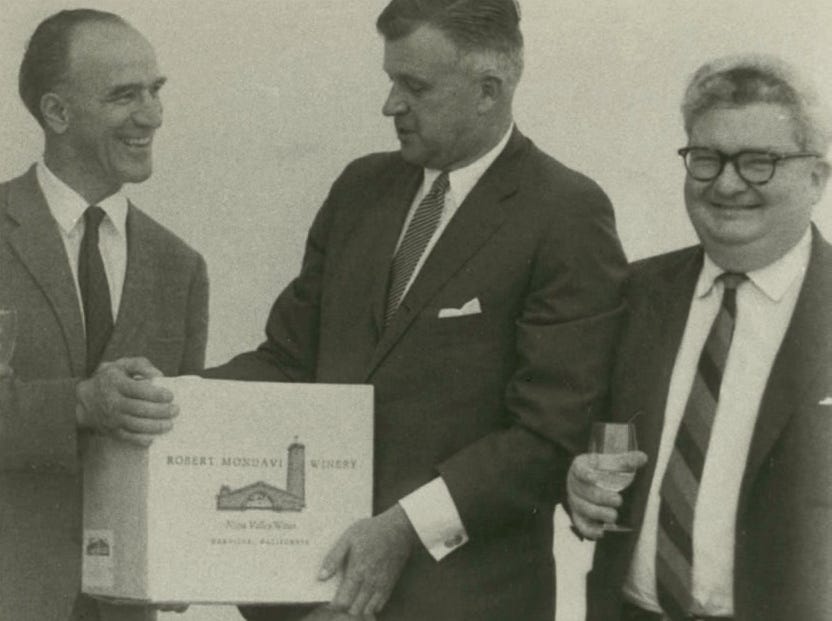
One of the more successful, and we should all be grateful for it, was the 1966 investment made by Seattle beer producer Rainier Brewing in the fledgling Robert Mondavi Winery. Rainier sought to diversify its portfolio, and the up-and-coming wine industry seemed like a good idea. It wasn’t too long a stay, though, as Rainier was acquired by G. Heileman Brewing in 1977, and Rainier divested itself of the Mondavi investment. This highlights an interesting moment in the beverage industry history: a beer company supporting the growth of what would become a legendary wine brand. Was this, in fact, a testament to the interconnectedness of the beer and wine industries? We’ll see.
Coca-Cola’s foray into the wine industry was, shall we say, pioneering. In the late 1970s, Coke decided to diversify its portfolio by entering the wine space, too. This wasn’t an unusual move for large corporations anyway, and since beverages are beverages, why not?
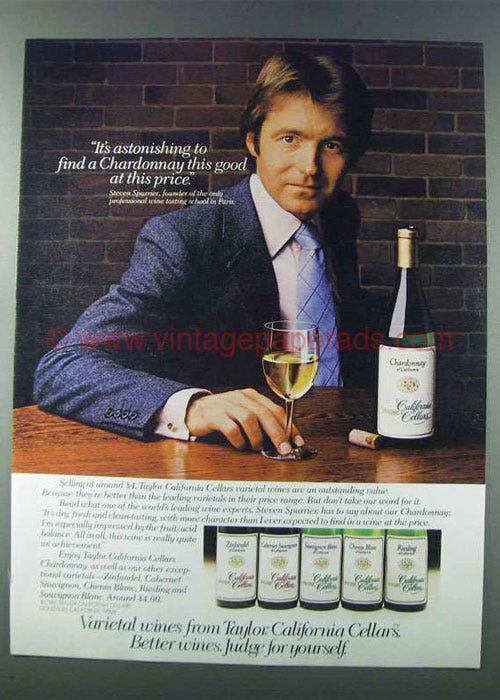
In 1977, Coca-Cola acquired the Taylor Wine Company, a well-established winery in New York's Finger Lakes region known for its wide range of mostly generic wines, including sparkling and fortified wines. I’m old enough to remember that as a clerk in a wine shop in Wilmington, DE, some 35 years ago, Taylor was the best-selling wine (overall) in the store, much to the chagrin of the local Gallo sales team.
Following the Taylor acquisition, Coca-Cola purchased the Monterey Vineyard in California in 1977. Then, it consolidated its wine holdings under a new subsidiary called The Wine Spectrum. However, Coke struggled with the competition, especially Gallo, and the natural distribution avenues of wine were different than for soft drinks. Coke’s brand identity didn’t translate in any positive way to the wine side, and while their investments were very much in the generic wine ranges, consumers started warming to the fighting varietals and far more premium products into the 1980s. I remember as a very young wine guy being interminably disappointed with the new premium varietals produced at the Monterey Vineyard – technology hadn’t quite caught up to the natural dominance of pyrazines in those wines – all of them smelled and tasted like green bell peppers. Some of them were downright awful.
Not too long after, in 1983, Coca-Cola sold The Wine Spectrum to Seagram, the Canadian conglomerate, and with that, Coke was out of the wine business. This almost comical historical episode serves as a valuable lesson in the importance of aligning new ventures with core business strengths and the hubris behind a beverages are beverages mentality. Take a look at this great article in Vinepair from 2020.
Seagram, best known for Crown Royal, Chivas Regal, and Seagram’s 7, aggressively expanded into the wine industry in the 1970s and 1980s when it acquired several prominent wine brands, including Mumm Champagne, Perrier-Jouët, and Barton & Guestier. By the late 1990s, Seagram began to struggle with its wine investments. The wine business was, and still is, highly competitive and requires very specific expertise apart from spirits. In 2000, Seagram sold its wine and spirits division to Diageo and Pernod Ricard for $8.15 billion, marking its exit from the wine industry.
Diageo, the world’s largest spirits producer (known for Johnnie Walker, Smirnoff, and many more), entered the wine industry in the early 2000s. It acquired several premium wine brands, including Beaulieu Vineyard, Sterling, and Chalone (Group), spending over a billion dollars on wine assets—$260 million for Chalone alone. Still, Diageo struggled to integrate these wine brands into its predominantly spirits-focused business. Wine requires different distribution channels and different marketing strategies, and typically, these are different consumers. In 2015, Diageo sold most of its wine portfolio to Treasury Wine Estates for $552 million, a very significant loss, unfortunately.
This reminds me of the first time I was ever laid off from a job. I was one of seventeen regional sales representatives for Remy-Amerique’s wine division, called Premier Wine Merchants, headed by the legendary Bob Shack. Remy-Cointreau acquired Champagne Krug in the 1970s and later sold it to LVMH in 1999. In the 80s, Remy acquired Piper-Heidsieck and Charles Heidsieck and later sold them in 2011 to Européenne de Participation Industrielle as part of Remy’s strategy to concentrate on spirits. In 2000, I was called into the office of the CEO of Remy-Amerique and released from my job, along with all the other fellows in the division, albeit with an extremely generous severance package (the kind of thing that doesn’t happen much anymore). I asked the CEO why, of course, and his reply is still meaningful and relevant 25 years later. He said, “Well, Jim, Premiere is 40% of our traffic, 30% of our labor, and 2% of our bottom line…” Having never lost a job before, and a bit dazed, I walked down Manhattan’s Sixth Ave for an hour before I realized I had passed by my parking lot 30 blocks earlier.
Industry folks with long memories will remember that Fortune Brands, the parent company of Jim Beam and Maker’s Mark, had also dabbled in the wine industry, eventually owning several wine brands, including Clos du Bois, Geyser Peak, and Wild Horse. But by 2011, it had spun off its spirits business as Beam Inc. and later sold its entire wine portfolio (as Beam Wine Estates) to Constellation Brands for $885 million.
Pernod Ricard, the global spirits giant that includes Absolut Vodka and Jameson, has historically maintained a relatively small wine portfolio, including brands like Jacob’s Creek, acquired in 1989, and Brancott Estate. Some of Pernod’s wine holdings came from the joint takeover of Allied-Domecq (with Fortune Brands) in 2005. Pernod hasn’t exited everything just yet, but it has certainly scaled back the wine operations quite a bit and naturally has announced it will sell all of it to an Australian holding company sometime later this year.
And then there’s Brown-Forman, who most of us know better as Jack Daniel’s and Woodford Reserve Bourbon, among many other (truly) quality products. (Even as a purist, usually preferring Sazerac rye in my Manhattan cocktails, Woodford makes an absolutely splendid Manhattan.)
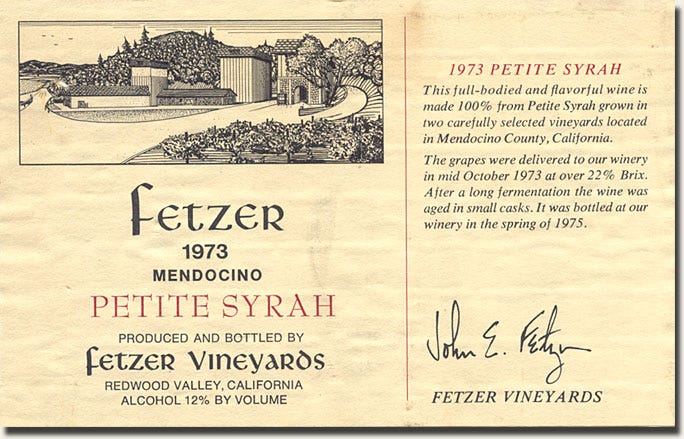
B-F acquired Mendocino’s Fetzer Vineyards in 1992 for $77 million and later expanded its wine portfolio with brands like Bonterra. It invested heavily and enjoyed a lot of success early on. However, as you may have guessed, Brown-Forman struggled to achieve the same profitability in wine as it did in spirits. In 2011, it sold Fetzer Vineyards and its wine brands to the Chilean group Viña Concha y Toro for $238 million, a modest return given the years of investment. It also sold the mighty Chardonnay brand Sonoma-Cutrer to Duckhorn last year in exchange for cash and stock.
Of course, B-F still owns the somehow immortal sparkling wine producer Korbel. But if you are paying attention to the rumblings across the industry, their recent restructuring and closing of their own cooperage facilities are distressing in some ways. Perhaps it's easier to match the production and marketing of sparkling wines to spirits, but then I’m just musing out loud here…
My point is that while wine and spirits may seem similar, they require distinct strategies, expertise, and market approaches. Constellation seems to know this now, not that anyone would or should doubt this juggernaut’s machinations.
Constellation Brands list of acquisitions is almost too long, but includes Robert Mondavi (and Opus One) in 2004 for $1.03 billion; Ravenswood for $148 million; Clos du Bois in 2015 for $165 million; Blackstone Winery for $144 million, riding that Merlot wave until it hit the beach; The Wine Group, including Franzia, Concannon, and Mad-Dog Mogen David, $290 million; Vincor, including Inniskillin, Jackson-Triggs, and Kim Crawford for $1.1 billion; The Prisoner Wine Company, including Prisoner, Saldo, and Cuttings among others; Schrader Cellars (a 2,500 case per year wine producer with no vineyards and no winery, for a rumored $65 million, wonder what that was about*…) And we really haven’t even touched on the 2015 acquisition of Meiomi (just the brand) for $315 million.
Constellation has already divested itself of its Canadian wineries to a pension fund, and the lower shelf wines like Arbor Mist and Cook’s, plus Clos du Bois, the Asti Winery, and Ravenswood, all to Gallo; Almaden and Inglenook to the Wine Group. It sold off Nobilo to Treasury and Paul Masson (Brandy) to Sazerac – clearly not interested at all in the low end of the market, which in hindsight was rather prescient.
The divestitures often occurred 5 to 20 years after acquisition, depending on the brand and market conditions. This strategy has allowed Constellation to maintain a strong position while the industry is growing. Now that the industry is in what can only be described as a recession, they will sell them off, floating safely on a deep sea of Modelo and Corona.
Good for business, perhaps or perhaps not, but this behavior is the very antithesis of wine’s traditional long-term vision.
The trend here is a good one: wine and wineries for the wine business. Wine people in control of the wine space is healthier than wine bound up or intertwined with spirits and beer. An appreciation, nay, respect for terroir and other high-concept tenets of wine can often clash with decision-making that is subservient to shareholders, profits, and, yes, growth. The dilution of message and brand, storytelling, authenticity, and art happens in a conglomerate; it’s unavoidable and demonstrably true when you look back on the history we just reviewed. We can point to dozens of magnificent brands supposedly ruined by their acquisition. I believe it; you probably do too. In contrast to that, what an impressive piece of work it must have been, and continues to be, to preserve BV’s legacy and history almost perfectly intact. Bravo to them, absolutely.
No one must lament Duckhorn and Delicato's takeover of the Constellation assets, as these are wine companies, and wine companies can build and preserve wine businesses. That Duckhorn is private again is more good news, and certainly, Delicato epitomizes that grand “long-term vision.”
Enough hand-wringing. Wine companies focused on their wine assets will build trust among consumers and tell better stories. Efficiencies and sustainability are less “forced” by executives trying to cram spirits into the wine space or vice versa and are more naturally occurring. Stewardship of the land and vineyard assets is more focused on preservation, and contracts are better respected and appreciated. In a time when expertise is dying all around us, wine-centric companies breed more wine experts and innovation. E. and J. Gallo prove my point. At a time when all of us lament the corporatization of wine, we can at least be glad “Big Wine” is Big Wine, and not Big whatever Constellation is…
The history of rich guys buying lifestyle wineries is the same as the history of rich conglomerates buying wineries, knowing full well they are barely profitable, if at all. Unless your Mom and Dad bought the place between 1972 and 1983, you’re probably not making a ton of money without scale - and scale is sustaining a lot of wine right now.
* Answer - The mailing list, of course!